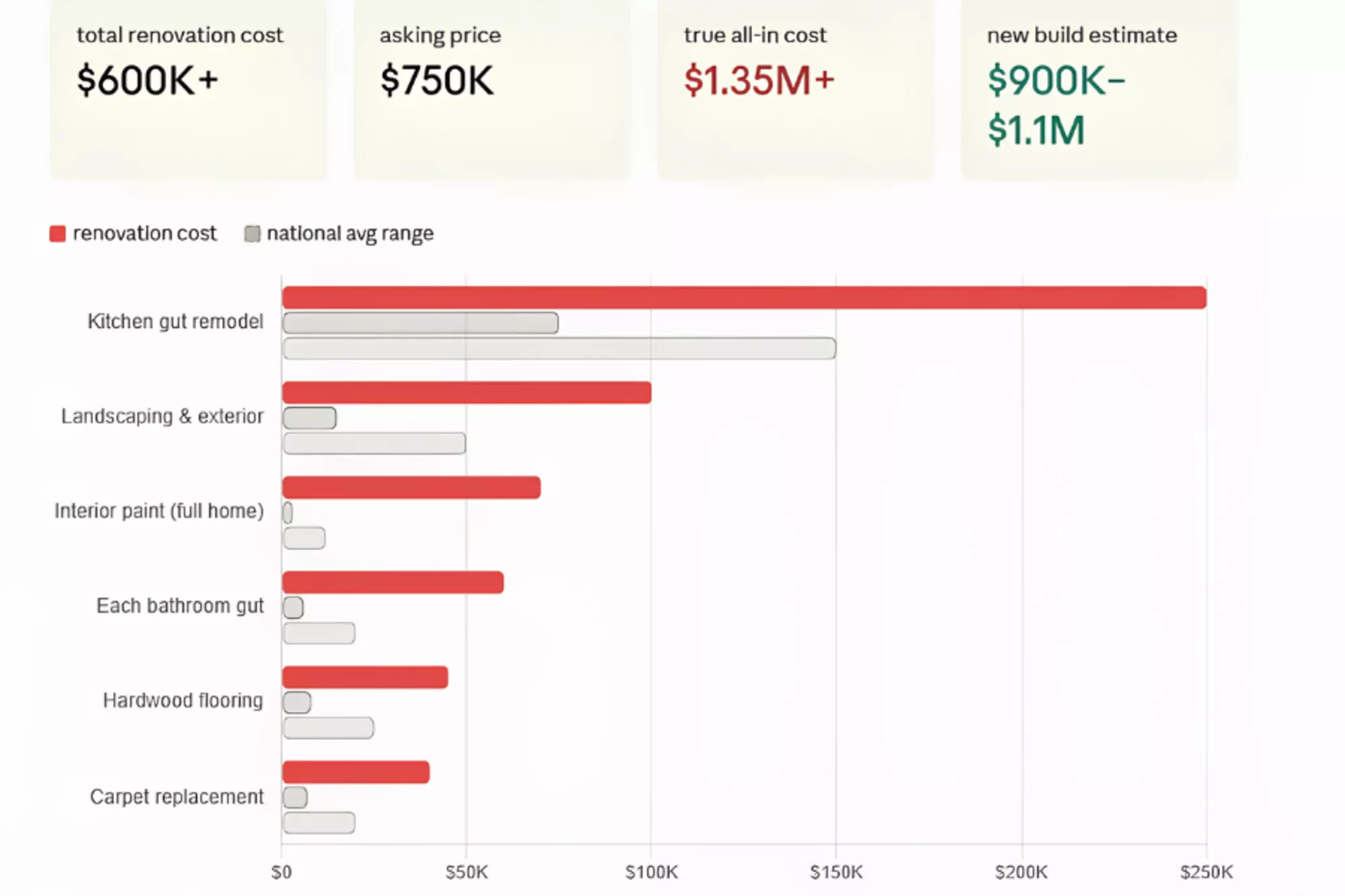
 Sources: HomeAdvisor Cost Guide 2025, Angi Remodel Report 2024, NKBA Kitchen Cost Study 2025, Remodeling Magazine Cost vs. Value 2025, NAHB Construction Cost Survey 2025. Ranges reflect national mid-range to high-end finishes. Milwaukee/North Shore market costs may run 8–14% above national average.
The Hidden Price Tag: What Buyers Don't Know About Remodeling in 2026
There is a question every buyer should ask before making an offer and almost none of them do.
Not "What's the price?" Not "How are the schools?" The question is this: What will it actually cost to make this house the home I want?
In 2026, that answer is more important and more expensive than at any point in recent memory. And the agent sitting across the table from you had better know how to answer it.
The Walk-Through That Changed the Math
Last week I toured a home in Elm Grove with a buyer. The owner is asking $750,000. The property was built in the 1950s, and it shows. Worn carpet throughout the home. A kitchen that needs a complete gut. Three bathrooms that haven't been touched since the original build. Floors in rough shape. Paint that's long overdue. Landscaping that would take significant investment just to get to neutral.
Before my buyer fell in love with the price, I sat down and walked through the real numbers:
- Carpet replacement: $40,000
- Kitchen gut remodel with high-end appliances: $250,000
- Each bathroom gut remodel: $60,000 — multiply that by three
- Hardwood flooring throughout: $40,000–$50,000
- Interior paint alone: $70,000
- Landscaping and exterior: $100,000+
We hadn't even touched the mechanicals, the roof, or the windows.
The cost to bring this house up to a standard consistent with the $750,000 ask: north of $600,000. Which means a buyer who "gets a deal" at $750,000 is really looking at a $1.35 million home with none of the upside of new construction and all the headaches of a 1950s infrastructure underneath.
I suggested to my buyer that the math actually pointed toward tearing it down and starting fresh.
The Problem Isn't Just the Price — It's the Infrastructure
Here is the part buyers consistently miss, even the ones who understand construction costs.
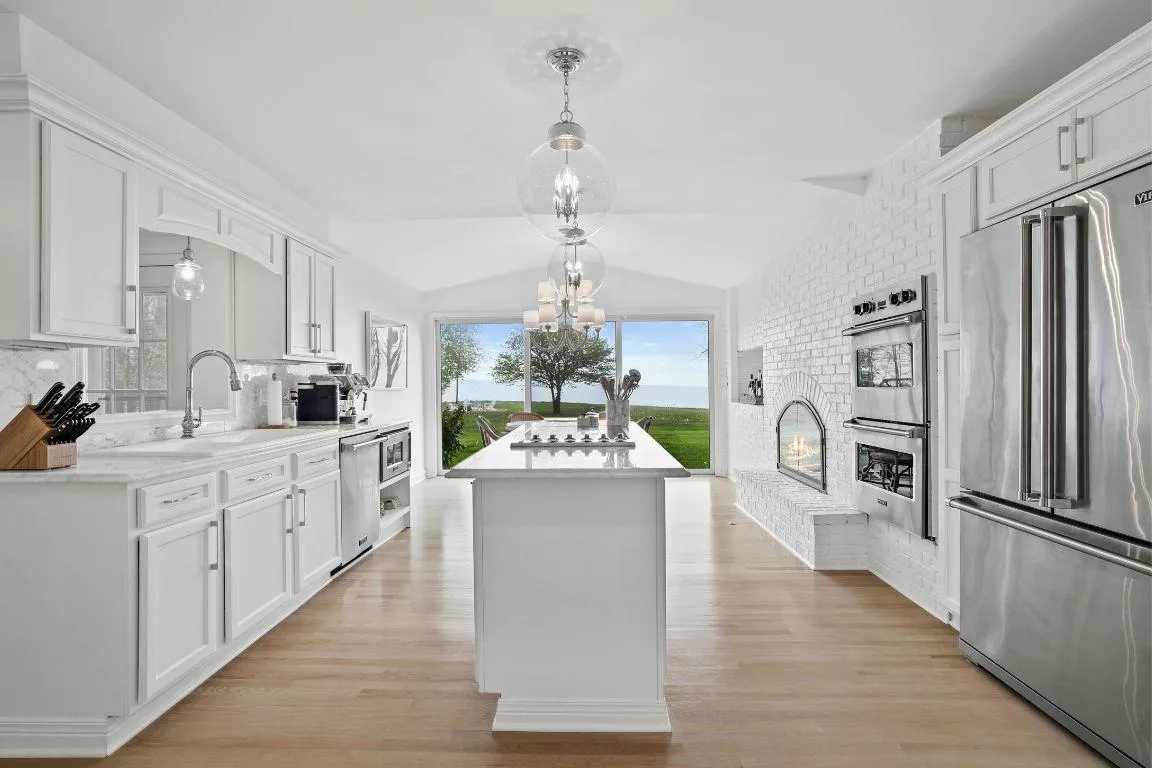
When you gut renovate an older home, you are putting new finishes on old bones. You can have a stunning kitchen with a new island and Wolf appliances. The electrical panel behind it may be original. The plumbing running to it may be cast iron. The insulation in the walls around it may be whatever was common in 1952.
Even after you spend $600,000 even after the home looks like it belongs on a magazine cover you cannot get your money out. The market will not pay you $1.35 million for a renovated 1950s split-level ranch in a neighborhood where the comps don't support it. You've invested your capital into an asset you can't exit on favorable terms.
New construction gives you a clean envelope: modern mechanicals, current code compliance, energy efficiency, warranties. An old infrastructure gives you a beautiful surface over decades of accumulated decisions you didn't make and can't fully see.
The Labor Crisis No One Is Talking About
There is another dimension to this conversation that doesn't show up in any cost calculator.
Finding skilled tradespeople in 2026 is hard. Genuinely hard. My carpenter is 72 years old. My other trusted carpenter is in his 60s. These are craftsmen who know what they're doing, who show up when they say they will, and who take pride in the finished product. When they retire, I don't know who replaces them.
The skilled trades pipeline in this country has been draining for thirty years. In markets like Florida, the situation is already critical. In Wisconsin, we are not immune. The tradespeople who can execute a $250,000 kitchen renovation at a high level are not standing by, waiting for your call. Many of them are booked months out. Some won't take new clients. The ones who are available on short notice often command premium pricing and that premium is only going up.
When you buy a home that needs significant work, you are not just managing a construction budget. You are managing a supply chain that is increasingly constrained.
Condition Is the Offer
In this market, condition has become one of the primary drivers of a successful offer.
Buyers are more sophisticated than they were five years ago. They've seen inflation. They've been through supply chain disruptions. They know or they've started to learn that a $30,000 credit does not fully offset $150,000 of needed work, because the credit doesn't account for the time, the disruption, or the difficulty of finding qualified people to do the job.
The homes that are getting strong offers, fast, are the homes that are done. Buyers are increasingly willing to pay for the privilege of moving in and not having to manage a renovation. That premium is real, and it is growing.
What a Good Agent Actually Does Here
The role of an agent is not to tell buyers what they want to hear. It is to tell them what they need to know.
Understanding the realistic cost of a remodel not the HGTV version, not the optimistic contractor bid, but the real number that accounts for materials, labor, timeline, and the unexpected is one of the most valuable skills I can bring to a buyer relationship. It is also a skill that, frankly, many agents don't have. Not because they aren't working hard, but because this kind of knowledge is earned through years of sitting in jobsites, watching budgets evolve, and having hard conversations at the kitchen table.
The advice I give my buyers is consistent: buy the most done house you can. Not because fixer-uppers can't work financially in the right circumstances, with the right team, they can. But because in 2026, the margin for error is thinner than it has ever been, the cost of being wrong is higher, and the labor market will not bail you out.
Know what you're buying. Know what it will cost. And work with someone who can tell you the difference.
Suzanne Powers is the founder and CEO of Powers Realty Group, Wisconsin's #1 boutique brokerage specializing in luxury real estate on Milwaukee's North Shore. Real Estate Perspectives is published for buyers, sellers, and anyone who wants to understand the market the way professionals do.