The Majority Workforce, the Minority Ownership
Walk into almost any residential real estate office in America and you'll likely find women dominating the sales floor. Women are the negotiators, the marketers, the relationship builders, the top producers. The face and the engine of the industry.
Walk into the ownership suite or the executive leadership meeting, and the balance shifts dramatically.
This is not a perception problem. It is a data problem, and the data is now unambiguous.
The Numbers
An Industry of Women Who Don't Yet Lead
Real estate has become one of America's most female driven professions. The numbers are not close.
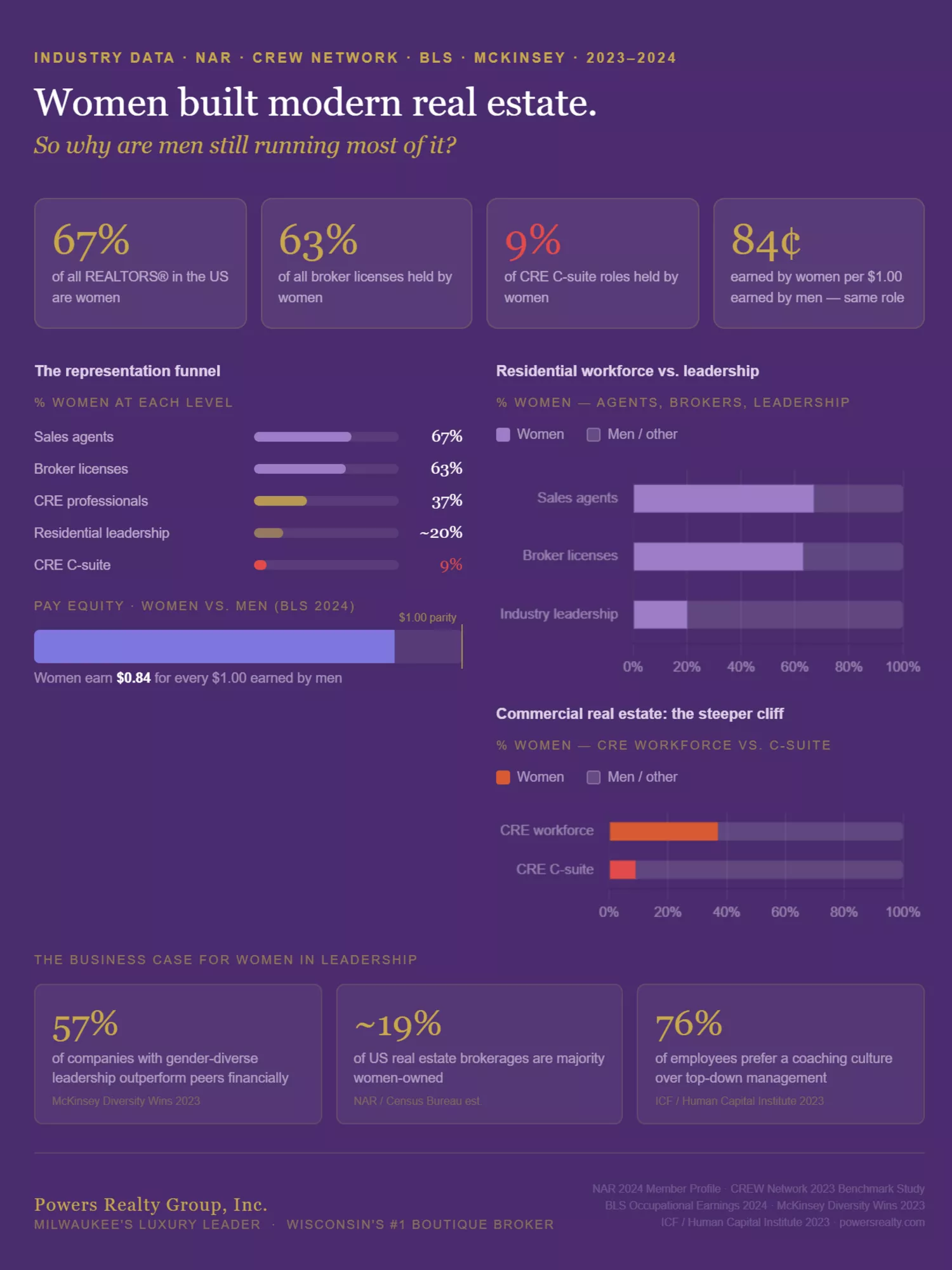
67% of all REALTORS® in the United States are women.
Source: NAR 2024 Member Profile, National Association of REALTORS®
63% of all broker licenses nationwide are held by women.
Source: NAR 2024 Member Profile
~20% of industry leadership positions in residential real estate are held by women despite women comprising the clear majority of the workforce.
Source: McKinsey & Company / LeanIn.org, Women in the Workplace 2023; real estate industry segment data
The disconnect is so typical. Women are doing the work. Women are earning the licenses. Women are building the client relationships that drive billions in transaction volume. Yet the boardrooms, ownership structures, and executive suites of the industry's largest companies continue to skew heavily male.
“Women make up the overwhelming majority of real estate agents, but when it comes to who owns the firms, who sits on the boards, and who controls the capital, the numbers tell a starkly different story.”
Commercial Real Estate
The Steeper Cliff
In commercial real estate, the leadership gap becomes even more pronounced and more difficult to rationalize.
37% of commercial real estate professionals are women.
Source: CREW Network 2023 Benchmark Study on Women in Commercial Real Estate
9% of C-suite executive positions in commercial real estate are held by women.
Source: CREW Network 2023 Benchmark Study on Women in Commercial Real Estate
The CREW Network, Commercial Real Estate Women has been tracking this data for over two decades. Their 2023 Benchmark Study found that while representation of women in the CRE workforce has grown steadily, the pipeline to senior leadership remains severely constricted.
Women enter the profession. They perform. They advance to mid level positions. And then, in striking numbers, they plateau or exit; a pattern the CREW study attributes to a combination of limited mentorship access, unconscious bias in promotion decisions, and a structural underrepresentation of women in the deal making and capital allocation roles that feed executive pipelines.
9% percent.
In an industry where relationship building, trust, communication, and client service are the core competencies and where women demonstrably excel by every measurable metric; only nine percent of C-suite roles belong to women.
That is not a pipeline problem. That is a structural problem.
The Pay Gap
The Myth of the Commission Only Meritocracy
One of the most persistent myths in real estate is that commission based compensation eliminates gender inequality. The argument goes: everyone earns what they produce, so the playing field is level.
The Bureau of Labor Statistics data does not support that claim.
$0.84 earned by women real estate brokers and sales agents for every $1.00 earned by their male counterparts in the same occupation.
Source: U.S. Bureau of Labor Statistics, Occupational Employment and Wage Statistics, 2023–2024
A sixteen cent gap in a profession that insists compensation is purely merit based. That gap does not appear because women are less skilled, less productive, or less committed. Research consistently points to differences in access: access to higher value listing inventory, access to luxury market segments, access to developer and institutional client relationships, and access to the networks where the largest transactions originate.
“The pay gap in real estate isn’t about effort. It’s about access to listings, to networks, to capital, and to the rooms where the biggest deals are made.”
The access gap is downstream of the leadership gap. When women don't run the companies, they don't control which agents get assigned to which listings. They don't control which relationships get cultivated. They don't set the culture that determines who gets mentored, promoted, and handed the keys to the firm.
Until women lead the companies, the gap persists.
Leadership Styles
Women Lead Differently.
For decades, leadership in real estate was modeled after a traditionally masculine framework: command, control, competition. The biggest personality in the room. The hardest closer. The loudest voice at the table.
The market has moved on.
Today's clients and today's agents want something different. They want authenticity. They want collaboration. They want leaders who listen, communicate clearly, build genuine trust, and develop the people around them rather than simply extracting performance from them.
76% of employees say they'd prefer to work for a company with a strong coaching culture over one with a traditional top down management structure.
Source: International Coaching Federation / Human Capital Institute, Building a Coaching Culture, 2023
Women leaders, on average, score higher than men on most of the competencies that define effective leadership in today's market: communication, empathy, team development, adaptability, and long term relationship orientation.
57% of companies with above average gender diversity at the leadership level outperform their industry peers financially.
Source: McKinsey & Company, Diversity Wins: How Inclusion Matters, 2023
The business case for female leadership is a performance argument.
Brokerages led by women, teams built around collaborative culture, firms that prioritize agent development over agent extraction these are increasingly the businesses winning in a market where talent retention and client loyalty determine long term success.
Ownership
The Most Important Word in Real Estate Is Not 'Agent.' It's 'Owner.'
If there is one strategic priority for the next generation of women in real estate, it is this: ownership.
Not management. Not top producer. Not team lead under someone else's flag.
Ownership.
Ownership creates wealth. Ownership creates leverage. Ownership creates the ability to build something that lasts beyond any individual transaction; a brand, a culture, a business that compounds over time.
~19% of real estate brokerages in the United States are majority women-owned, according to industry estimates - a figure that has grown but remains far below parity with women's overall representation in the profession.
Source: NAR Research Division estimates; U.S. Census Bureau Survey of Business Owners, latest available data
Every woman who launches a brokerage, a development company, an investment fund, or a real estate technology company expands the pipeline for the women who follow. Representation at the ownership level is not just personally valuable; it is structurally transformative for the entire profession.
“The future of real estate will not be shaped by who sells the most homes. It will be shaped by who owns the companies selling them.”
The Path Forward
What Has to Change and Who Has to Change It
Progress is real. Women are increasingly influencing luxury real estate, brokerage leadership, technology adoption, and industry innovation. Their presence in leadership continues to grow.
But progress is not the same as parity and comfortable progress is not the same as transformation.
Several structural shifts are required:
Mentorship pipelines that deliberately connect women to senior leadership
Access to capital for women who want to launch or acquire brokerages, development companies, and investment vehicles.
Industry organizations that measure and publish female leadership representation data
Women already in leadership who actively sponsor
And for every woman reading this who is still waiting for the right moment, the right market, the right level of experience to make her move toward ownership or leadership:
Stop waiting for a seat at the table. Build the table
ABOUT POWERS REALTY GROUP
Powers Realty Group is Wisconsin's #1 Boutique Broker and Milwaukee's Luxury Leader. We are an independent female owned brokerage founded on the conviction that excellence, integrity, and independence produce better outcomes for clients than franchise affiliation or institutional scale. Led by Suzanne Powers, Powers Realty Group, Inc. has served Milwaukee's North Shore communities for over two decades, consistently ranking #1 in the communities we serve.
Frequently Ask Questions
Why are women underrepresented in real estate leadership when they make up the majority of agents
It's one of the most striking contradictions in any industry. Women account for roughly 67% of all REALTORS® and hold 63% of broker licenses nationwide yet they occupy a fraction of executive leadership and ownership positions.
Research points to several overlapping causes: limited access to formal mentorship pipelines that connect performance to promotion, unconscious bias in leadership selection, underrepresentation in the capital intensive roles (investment, development, institutional sales) that feed executive pipelines, and a historically male ownership structure that replicates itself. The CREW Network's 2023 Benchmark Study identified mentorship gaps and exclusion from informal deal making networks as the two most commonly cited barriers by women in commercial real estate.
It's worth being direct: this is not a talent gap. It's an access gap.
What does the data actually say about women in real estate leadership today?
The numbers are clear and the contrast is striking.
67% of all REALTORS® are women (NAR 2024 Member Profile)
63% of broker licenses nationwide are held by women (NAR 2024)
~20% of residential real estate industry leadership positions are held by women
37% of commercial real estate professionals are women (CREW Network 2023)
9% of C suite roles in commercial real estate are held by women (CREW Network 2023)
Women dominate the workforce. They do not yet dominate ownership or executive leadership. Those two facts, held side by side, define the problem.
Is there really a gender pay gap in real estate? I thought commission-based work was a meritocracy
This is one of the most common misconceptions in the industry and the Bureau of Labor Statistics data corrects it plainly.
Women working as real estate brokers and sales agents earn approximately $0.84 for every $1.00 earned by men in the same occupation. That's a 16 cent gap in an industry that routinely argues commissions create a level playing field.
The gap persists not because women are less productive, but because of access: access to higher value listing inventory, luxury and commercial market segments, institutional client relationships, and the informal networks where the largest transactions originate. Women are less likely to be assigned high dollar listings at firms they don't own. They're less likely to be brought into the investment and development deals that generate outsized commissions. And they're underrepresented in the brokerage ownership positions that determine all of the above.
Commission based compensation rewards production. It does not automatically eliminate the structural factors that determine what production is possible.
What is the business case for having more women in real estate leadership?
The evidence is compelling and it's not just about fairness.
McKinsey's Diversity Wins research found that companies with above average gender diversity at the leadership level outperform their industry peers financially by 57%. That's not a marginal advantage.
In real estate specifically, the qualities associated with effective female leadership a collaborative culture, client centric communication, team development, long term relationship orientation align directly with what today's agents and clients want from their brokerage partners. Agent retention, client loyalty, and referral generation are all culture dependent outcomes. Culture is shaped by leadership.
Women led brokerages tend to invest more heavily in agent development, communication infrastructure, and client experience the exact inputs that drive long term performance in a relationship based industry.
The business case for female leadership in real estate is not a social argument. It is a performance argument.
What's happening in commercial real estate specifically; is it really that different from residential?
Commercial real estate has a more severe leadership gap than residential, and the CREW Network has been documenting it with precision for years.
Women represent 37% of the CRE workforce, a meaningful presence. But only 9% of C suite positions are held by women. That's not a pipeline that's slow to convert. That's a pipeline that breaks.
The CREW 2023 Benchmark Study found that women in CRE are most commonly employed in marketing, asset management, and property management roles functions that are important but structurally removed from the deal sourcing, capital allocation, and principal investment roles that historically feed executive leadership. The ladder exists. It just doesn't lead to the same floors.
Progress is happening slowly. More women are moving into brokerage, development, and investment leadership than ever before. But at the current rate of change, meaningful parity at the C suite level in commercial real estate is still decades away without deliberate structural intervention.
Why does brokerage ownership matter so much can't women lead through top production?
Top production is powerful. Ownership is transformative.
When you own the company, you control listing inventory assignment, agent development budgets, marketing resources, recruiting criteria, and the cultural standards that determine how everyone on your team performs and grows. You build equity, not just income. You create an asset that compounds one that can be passed on, sold, or leveraged in ways that a production record cannot.
There's also a multiplier effect. Every woman who owns a brokerage, development company, or investment vehicle expands the pathway for the women behind her. She hires differently. She mentors differently. She builds a culture that either widens or narrows the leadership pipeline for the next generation.
Top producers set the bar for performance. Owners set the conditions for everyone else's performance. Both matter but only one reshapes the industry.
What can the real estate industry do to close the leadership gap?
Several concrete changes would move the needle:
Mentorship that is explicitly tied to leadership pathways not just sales skill development. Many women in real estate are mentored on how to close more deals. Far fewer are mentored on how to own or run a company.
Sponsorship, not just mentorship. There's an important distinction: mentors advise, sponsors advocate. Women need leaders with influence who will actively put their names forward for ownership opportunities, board positions, and executive roles.
Capital access. Many women who want to launch or acquire brokerages face the same barriers women face across entrepreneurship: less access to startup capital, smaller
professional lending networks, and less inherited wealth to deploy. Industry organizations and lenders have a role to play here.
Transparent representation data. The industry tracks transaction volume, market share, and agent count obsessively. It tracks leadership representation poorly. What gets measured gets managed.
And perhaps most importantly: women already in leadership who actively create the conditions for the women behind them in hiring, promotion, mentorship, and culture building
How does Powers Realty Group, Inc. approach women's leadership in its own organization?
Powers Realty Group was built on the conviction that independence, excellence, and integrity produce better outcomes than institutional scale and that conviction applies as much to how we operate as to what we produce.
As a woman owned independent brokerage, Powers Realty Group, Inc. has navigated the same structural headwinds this article describes in industry organizations that favor large incumbents, a competitive landscape designed around franchise systems, and a market that frequently underestimates what a boutique firm led by a woman can achieve.
Our response has been to build something that speaks for itself.
We don't wait for a seat at the table. We built the table
Where can I learn more or get involved in advancing women's leadership in real estate?
Several organizations are doing meaningful work in this space:
CREW Network (crewnetwork.org) - the leading professional organization for women in commercial real estate, with chapters nationwide and the most rigorous industry research on gender representation.
NAR's Women's Council of REALTORS® (wcr.org) - the largest women's real estate organization in the United States, focused on leadership development and professional advancement.
NAWRB (nawrb.com) - the National Association of Women in Real Estate Businesses, focused specifically on housing industry entrepreneurship and business ownership for women.
For women interested in ownership specifically, the SBA's Women Owned Small Business program and SCORE's mentorship network both provide resources for launching or acquiring businesses in the real estate sector.
And if you're in the Milwaukee market and want to talk about what building an independent career in luxury real estate looks like we're always open to that conversation.